
How much of the music is yours when you compose with AI?
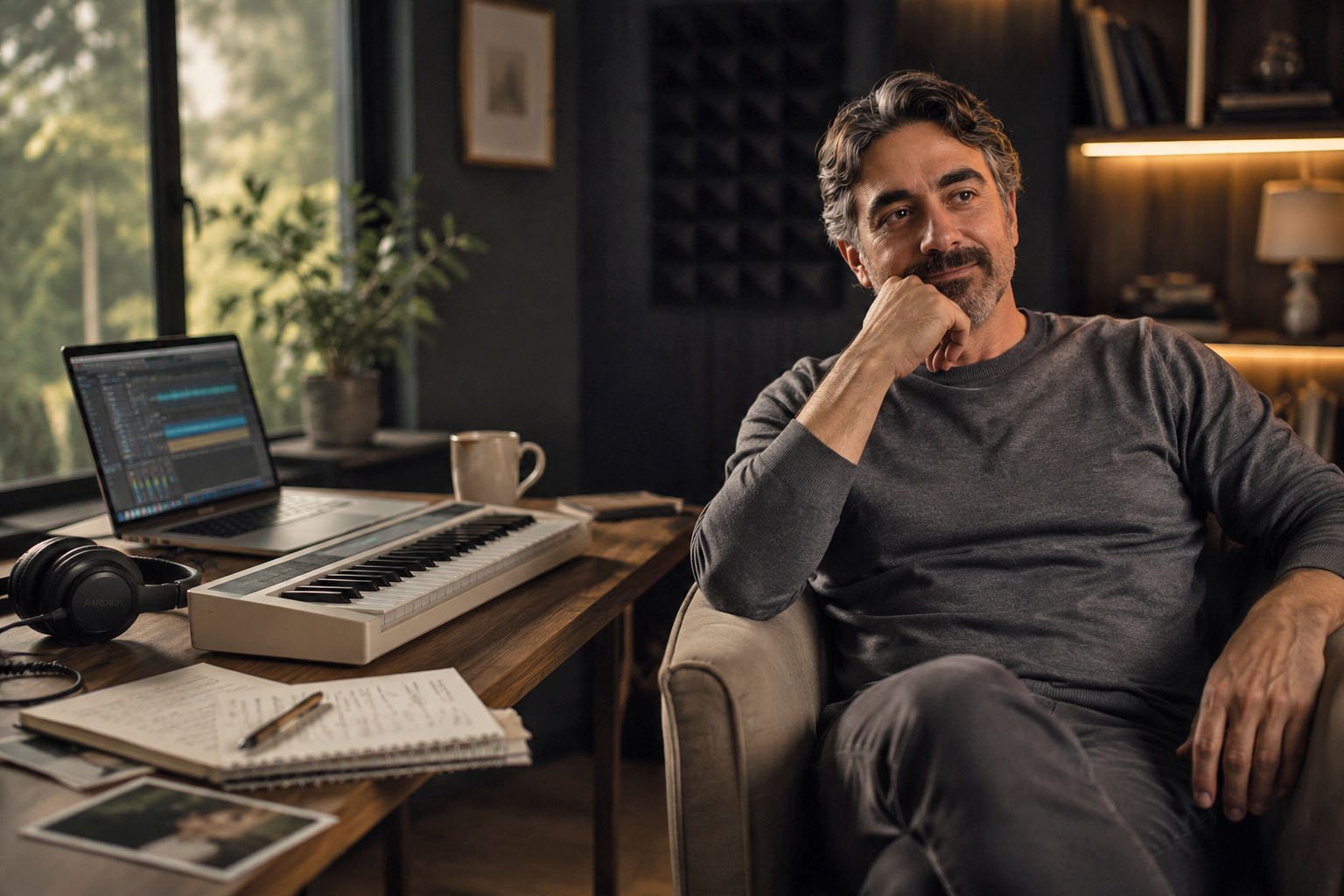
■ There is a case for and against composing music with the assistance of AI. In this post, I look at both sides of the argument.
I, for one, would have been unable to complete my first album had it not been for the help of AI. I don’t have a band, I can’t sing, and the few instruments I can play, at my level, would not have allowed me to create the music I like.
That said, I don’t consider prompting AI to be in any way the equivalent of composing music. Nor do I see much point in generating a complete track from a prompt and releasing it unchanged. Without an artistic process that involves you shaping the music, your contribution is limited to prompting and selection.
Used creatively, I see prompting as just the first step. You are like the lead personality in a band, telling skilled musicians what you would like to explore. You tell each of them independently what kind of bass line, tempo, mood or style you want.
You can begin by generating a rhythmic foundation that mixes a couple of instruments, but ideally you try to generate each instrumental track on its own. You explore several versions, then select and dissect them, by individual notes, groups of notes or fragments of sound. You assemble them, see what fits together and gradually build the different sections of your track.
I also like to mix in passages I have recorded on the piano, isolated sounds or outdoor recordings for ambient tracks. The key is that you determine the final sound.
I always finalise the instrumental part first, then add the a cappella voices. This is the hardest part, as I can generate only a few words at a time and must match the voice from one generation to the next. Most importantly, the words must suit the mood of the song and be in key. It can take hundreds of generations to get the vocals right for a single track.
It is a lot of work, and even if every note did not originate in my head, what I end up with is still recognisably my own music.
But with millions of people using AI to create music, and many looking for a shortcut in the hope of making money or attracting attention, there is also a strong case against it.
Let’s look at both sides.
When AI-Assisted composition is a plus
As my own example shows, AI allows people to create music when their musical imagination exceeds their technical abilities.
Traditionally, composing required years of instrumental training, knowledge of musical notation, access to musicians or mastery of production software. Those skills remain valuable, but they are no longer the only entrance to composition.
Someone who can recognise an evocative melody, shape an atmosphere and make strong creative decisions may now develop those ideas without being able to perform every part.
Used this way, AI is not necessarily the composer. It can function more like a group of endlessly available session musicians. You establish the concept and emotional direction. AI produces possible melodies, voices or instrumental passages. You then decide what has value and reject most of what is generated.
Fragments are selected, altered, combined, arranged and placed within a larger structure. The finished work acquires meaning through those decisions.
Examples in other media tell the same story. Photography did not eliminate visual composition because the camera performed the mechanical act of recording an image. Sampling did not eliminate musical composition because the original sounds came from elsewhere. Digital instruments did not become illegitimate because they simulated physical ones.
AI also encourages experimentation. A composer can try unfamiliar instruments, styles and arrangements almost immediately. Ideas that might previously have been abandoned because they were too difficult or expensive to realise can now be explored. The result may be music that would otherwise never have existed.
At its best, AI expands participation. It gives people access to a form of expression from which they may previously have been excluded.
When it raises concerns
The most serious criticism is that generative AI can replace creation with selection.
If someone enters a prompt, accepts one of the completed tracks and releases it unchanged, their contribution is negligible and, in my view, cannot be considered composition. They commissioned the result and selected what they liked.
The difficulty is that AI can create the impression of authorship without requiring the sustained engagement traditionally associated with it.
A person can produce hundreds of polished tracks rapidly and present them in the same spaces occupied by musicians who spent years developing their craft. This may flood those spaces with interchangeable work and make genuinely considered music harder to discover.
There are ethical objections as well. Generative systems are trained on vast bodies of existing human work, frequently without meaningful consent from the creators. AI voices may imitate the qualities of real singers while removing the singer from the process. Listeners may also feel deceived if synthetic performances are presented as human performances.
We should distinguish between different uses of AI-assisted music production. I would classify them into four groups:
- AI-generated music selected by a person: prompting a finished song and publishing it unchanged.
- AI-assisted composition and production: combining generated sections, rewriting lyrics and restructuring the track.
- Composition using AI-generated source material: using isolated AI-generated instruments or voices as material within a larger arrangement.
- Human composition with AI production assistance: writing and performing the music while using AI for cleaning, mastering or experimentation.
The boundaries are not absolute. I place myself in groups 2 and 3, but the amount and nature of human decision-making matter.
Effort alone does not make something your own: pressing “generate” hundreds of times is still different from shaping the internal structure of a piece. Conversely, creating music is not limited to playing an instrument. Listening, recognising potential, arranging, editing and creating emotional continuity are musical abilities too.
Leave a Reply